Today's
EarthStation1.com 15% Off Commemorative Memorial Title: Fibber
McGee And Molly Complete Radio Series MP3 DVD, Download, USB
Today, January 4, 2026
January 4: National Spaghetti Day: -- An
annual opportunity to pick your sauce and add it to that long,
thin cylindrical pasta of Italian and Sicilian origin! Usually
made from semolina flour, this pasta has been a worldwide favorite
for ages and loved by millions. There are various pasta dishes
based on spaghetti, and the sauce determines most of them. Some
examples include spaghetti ala Carbonara, garlic and oil, tomato
sauce, meat sauce, bolognese, Alfredo sauce, clam sauce, or other
sauces. In addition, we traditionally serve spaghetti dishes
topped with grated hard cheeses such as Pecorino Romano, Parmesan,
and Grana Padano. The word spaghetti is plural for the Italian
word spaghetto, which is a diminutive of spago, meaning "thin
string" or "twine." American restaurants offered
spaghetti around the end of the 19th century as Spaghetti
Italienne (which is believed to have consisted of noodles cooked
past al dente and a mild tomato sauce flavored with easily found
spices and vegetables such as cloves, bay leaves, and garlic).
Decades later, cooks added oregano and basil to many recipes.
There is a significant debate on the origin of spaghetti. However,
we do know that we've been consuming pasta for many, many years.
There are records in the Jerusalem Talmud of Itrium, a kind of
boiled dough commonly available in Palestine from the 3rd to 5th
centuries AD. A 9th-century Arab dictionary describes itriyyaas as
string-like shapes made of semolina and dried before cooking. A
1154 writing for the Norman King of Sicily, mentions itriyya as
being manufactured and exported from Norman Sicily. Dried pasta
became popular in the 14th and 15th centuries due to its easy
storage. People stored the dried pasta in ships when exploring the
New World. A century later, pasta was present around the globe
during the voyages of discovery. In March of 2009, the world
record for the largest bowl of spaghetti was set and then reset in
March of 2010 when a Garden Grove California Buca di Beppo
restaurant successfully filled a swimming pool with more than
13,780 pounds of pasta. Sung to the tune of "On Top of Old
Smoky," the fun children's song, "On Top of Spaghetti,"
was written and originally sung by folk singer Tom Glazer with the
Do-Re-Mi Children's Chorus in 1963: "On top of spaghetti, All
covered with cheese, I lost my poor meatball, When somebody
sneezed. It rolled off the table, And on to the floor, And then my
poor meatball, Rolled out of the door." Make your favorite
spaghetti dish, and be sure to make enough to share. Of course,
you can always invite friends to join you at your favorite Italian
restaurant and split a plate. If you do, be sure to tag the
restaurant and use #NationalSpaghettiDay to post on social media!
On Sale @ 15% Off Discount Till Midnight PT!
https://store.earthstation1.com/fibber-mcgee-and-molly-mp3-dvd-complete-radio-serie3.html
Today's
EarthStation1.com 15% Off Commemorative Memorial Title: 25x5: The
Continuing Adventures Of The Rolling Stones DVD, MP4, USB
Today, January 4, 2026
January 4: Pop Music Chart Day: -- Isn't
music an amazing way to tune up the new year? Pop music is catchy
and difficult to resist. Even if it's not your typical jam, you've
probably bobbed your head to a pop song or two, and you may even
know a few. Pop music is currently the most popular type of music
and there's a chart every week. While some songs stay on the
charts for a week, others that are more popular can stay on the
charts for months. The origin of Pop Music Chart Day is unknown.
However, pop is a genre of popular music that emerged in its
recent form during the 1950s in the United States and the United
Kingdom. During the 1950s and 1960s, pop music incorporated rock
and roll and the youth-focused behaviors it influenced. Pop music
was somewhat similar to rock, until the late 1960s, then pop
became associated with music that was more commercial, convenient,
and short. Popular music and pop music are often used to mean the
same type of music, but popular music equally relates to all music
that is popular and comprises many different styles. Although a
significant percentage of the music that features on record charts
is seen as pop music, the genre is different from chart music.
Factors that are common in pop music include the repeated choruses
and hooks, short and medium-length songs, which are often about
two to three minutes in length, and the lyrics in a basic format
(often the verse-chorus structure). Pop music features rhythms or
tempos that can be easily danced to, making it more commercial.
Much of pop music also borrows elements from other styles such as
dance, rock, indie, urban, Latin, and country. On Pop Music Chart
Day, the countdown of the top 10 or five songs on the chart is
played. These top songs are usually popular hit songs loved by
most. Many pubs and restaurants will blast these pop songs on Pop
Music Chart Day and pop music events and festivities will be
organized to celebrate. On Sale @ 15% Off Discount Till Midnight
PT!
https://store.earthstation1.com/25x5-the-continuing-adventures-of-the-rolling-stones-dvd-mp42554.html
Today's
EarthStation1.com 15% Off Commemorative Memorial Title: Jack Benny
Presents Golden Memories Of Radio LPs CD, MP3 Download, USB
Today, January 4, 2026
January 4: National Trivia Day: -- Q:
What National Day on January 4th celebrates those who accumulate
and hoard tidbits of trivia? A: National Trivia Day, of course!
The holiday recognizes the collectors of data, facts, history, and
quotes each year. They are the ones who usually proffer these
sometimes astounding bits of history when friends and family least
expect it._In ancient times, the term "trivia" was
appropriated to mean something very new. Nostalgic college
students in the 1960s began to informally trade questions and
answers about the popular culture of their youth. After writing
trivia columns, Columbia University students Ed Goodgold and Dan
Carlinsky created the earliest inter-collegiate quiz bowls. They
tested culturally (and emotionally) significant information. The
students dubbed the tests trivia contests. They later published
Trivia (Dell, 1966), the first book treating trivia in the
revolutionary new sense. This book also achieved a ranking on the
New York Times bestseller list. Over time, the word "trivia"
has come to refer to obscure and arcane bits of knowledge. It also
refers to nostalgic remembrances of pop culture. The first season
of the popular television trivia show Jeopardy! premiered on March
30, 1964._ Are you into trivia? Challenge someone to a trivia
contest, attend a trivia night, or host one at home. Show off your
trivia savvy! Robert L Birch of Puns Corps. founded National
Trivia Day. The first celebration took place as early as 1980, a
year before the popular board game, Trivial
Pursuit_debuted._Trivia games exercise your brain and expose you
to new information. Playing trivia games may improve cognitive
skills such as memory, creativity, and problem-solving. Anyone can
dominate a specific category, especially if it's something they
are knowledgeable in. Those who have the answers for nearly every
category tend to read a lot and have a terrific recall. Gather a
team of people with different interests, and you could be on the
winning team! On Sale @ 15% Off Discount Till Midnight PT!
https://store.earthstation1.com/jack-benny-presents-golden-memories-of-radio-6-album-set-mp3-63.html
Today's
EarthStation1.com 15% Off Commemorative Memorial Title: Helen
Keller: In Her Story + Bonus Biography DVD, Download, USB Drive
Today, January 4, 2026
January 4: World Braille Day: --
Celebrated to honor the birth of Braille's inventor, Louis
Braille. Braille's gift to the world has brightened the lives of
millions of people around the world who are blind or visually
impaired, and they benefit from his work every day. The day also
acknowledges that those with visual impairments deserve the same
standard of human rights as everyone else. The term 'Braille' was
dubbed after its creator. Louis Braille was a Frenchman who lost
his eyesight as a child when he accidentally stabbed himself in
the eye with his father's awl. From the age of 10, he spent time
at the Royal Institute for Blind Youth in France, where he
formulated and perfected the system of raised dots that eventually
became known as Braille. Braille completed his work, developing a
code based on cells with six dots, making it possible for a
fingertip to feel the entire cell unit with one touch and moving
quickly from one cell to the next. Eventually, Braille slowly came
to be accepted throughout the world as the main form of written
information for blind people. Unfortunately, Braille didn't have
the opportunity to see how useful his invention had become. He
passed away in 1852, two years before the Royal Institute began
teaching Braille. Braille's marvelous aid that opened up a world
of accessibility to the blind and visually impaired was recognized
by the United Nations General Assembly (UNGA). In November 2018,
January 4 was declared World Braille Day. The first-ever World
Braille Day was commemorated the following year and it was
celebrated as an international holiday. The date for the event, as
chosen by UNGA via a proclamation, marks Louis Braille's birthday.
We love to see people coming together to celebrate events and good
causes, and World Braille Day on January 4 is one such event! On
Sale @ 15% Off Discount Till Midnight PT!
https://store.earthstation1.com/helen-keller-in-her-story-dvd-plus-bonus-biography.html
Today's
EarthStation1.com 15% Off Commemorative Memorial Title: Long John
Nebel UFO & Paranormal Radio Show MP3 Set DVD, Download, USB
Today, January 4, 2026
January 4: World Hypnotism Day: -- While
it may be a complex subject, there's no denying that hypnosis by a
certified hypnotist can be beneficial in many ways. This day
serves to dispel the common misconceptions and fears surrounding
hypnosis. The origin of hypnosis in Western science can be traced
back to 1770. Franz Mesmer, born in 1734, was a German physician
who used hypnosis as a form of therapy to treat his patients in
Vienna and Paris. Mesmer's method interested other medical
practitioners and they called it mesmerism after his name.
Unfortunately, hypnosis was mistaken for an occultist practice,
and it was suppressed. Later on, Scottish surgeon James Braid came
up with the terms 'hypnotism' and 'hypnosis'. In 2004, Board
Certified Hypnotist Tom Nicoli and the World Hypnotism Day
Committee began the observance to motivate hypnotism experts to
educate people and promote the real benefits of and truth about
hypnosis. The initial observance kicked off myth-busting events
that provided proof, free consultations and an awareness of the
part hypnosis can play in our health. World Hypnotism Day on
January 4 emphasizes the fact that hypnosis is beneficial. On this
day, we are encouraged to eliminate the misconceptions and
misunderstandings about hypnotism and to truly embrace it as the
useful aid that it is. When under hypnosis, a person will see,
feel, smell, and perceive in harmony with the hypnotist's
guidance, even if these guides are in obvious contradiction to the
actual stimuli existing in the environment. Apparent outcomes of
hypnosis are sensory changes, the subject's memory and
self-awareness are altered by guidance, and the effects of this
guidance may be felt (post-hypnotically) even after the subject
wakes up. Hypnosis is a life-changing opportunity. It is a way for
someone to write new chapters in their life, so to speak. On Sale
@ 15% Off Discount Till Midnight PT!
https://store.earthstation1.com/complete-long-john-nebel-old-time-radio-broadcasts-mp3-dv3.html
Today's
EarthStation1.com 15% Off Commemorative Memorial Title: To The
Moon: The Story In Sound Set CD, MP3 Download, USB Flash Drive
Today, January 4, 2026
January 4, 1959: The History Of
Spaceflight: The Cold War: The Space Age: The Space Race: Missions
To The Moon: Space Probes: Lunar Space Probes: The Soviet Space
Program: The Luna Programme (Pejorative: The Lunik Program): Outer
Space Firsts: Luna 1 (Russian: Mechta, "Dream"): -- Luna
1 becomes the first spacecraft to reach the vicinity of the Moon.
On January 2, 1959: Luna 1 was launched atop a Luna 8K72 launch
vehicle (derived from the R-7 Semyorka design) from the Baikonur
Cosmodrome's Launch Site 1/5 (now known as Gagarin's Start Launch
Site) by the Soviet Union. It was the first spacecraft to reach
the vicinity of the Earth's Moon, and the first spacecraft to be
placed in heliocentric orbit. Intended as an impactor, Luna 1 was
launched as part of the Soviet Luna programme in 1959, however due
to an incorrectly timed upper stage burn during its launch, it
missed the Moon, in the process becoming the first spacecraft to
leave geocentric orbit. While traveling through the outer Van
Allen radiation belt, the spacecraft's scintillator made
observations indicating that a small number of high energy
particles exist in the outer belt. The measurements obtained
during this mission provided new data on the Earth's radiation
belt and outer space. The Moon was found to have no detectable
magnetic field. The first ever direct observations and
measurements of the solar wind, a strong flow of ionized plasma
emanating from the Sun and streaming through interplanetary space,
were performed. The spacecraft also marked the first instance of
radio communication at the half-million-kilometer distance. A
malfunction in the ground-based control system caused an error in
the rocket's burntime, and the spacecraft missed the target and
flew by the Moon at a distance of 5,900 km at the closest point.
Luna 1 then became the first man-made object to reach heliocentric
orbit and was then dubbed a "new planet" and renamed
Mechta (Dream). Luna 1 was also referred to as the "First
Cosmic Rocket", in reference to its achievement of escape
velocity. On Sale @ 15% Off Discount Till Midnight PT!
https://store.earthstation1.com/to-the-moon-the-story-in-sound-complete-6-album-set-mp3-63.html
Today's
EarthStation1.com 15% Off Commemorative Memorial Title: Isaac
Newton: Portraits Of Newton Documentary MP4 Video Download DVD
Today, January 4, 2026
January 4, 1643 (Gregorian New Style
Calendar): #BOTD: #HBD! Isaac Newton, English mathematician,
astronomer, theologian and physicist (described in his own day as
a "natural philosopher") who is widely recognised as one
of the most influential scientists of all time and a key figure in
the scientific revolution, and whose book Philosophiae Naturalis
Principia Mathematica ("Mathematical Principles of Natural
Philosophy"), first published in 1687, laid the foundations
of classical mechanics (d. March 31, 1727) is #born in
Woolsthorpe, Lincolnshire, England "an hour or two after
midnight". Sir Isaac Newton PRS also made pathbreaking
contributions to optics, and he shares credit with Gottfried
Wilhelm Leibniz for developing the infinitesimal calculus.
Newton's Principia formulated the laws of motion and universal
gravitation that dominated scientists' view of the physical
universe for the next three centuries. By deriving Kepler's laws
of planetary motion from his mathematical description of gravity,
and using the same principles to account for the trajectories of
comets, the tides, the precession of the equinoxes, and other
phenomena, Newton removed the last doubts about the validity of
the heliocentric model of the Solar System and demonstrated that
the motion of objects on Earth and of celestial bodies could be
accounted for by the same principles. Newton's theoretical
prediction that the Earth is shaped as an oblate spheroid was
later vindicated by the geodetic measurements of Maupertuis, La
Condamine, and others, thus convincing most Continental European
scientists of the superiority of Newtonian mechanics over the
earlier system of Descartes. Newton also built the first practical
reflecting telescope and developed a sophisticated theory of
colour based on the observation that a prism decomposes white
light into the colours of the visible spectrum. Newton's work on
light was collected in his highly influential book Opticks, first
published in 1704. He also formulated an empirical law of cooling,
made the first theoretical calculation of the speed of sound, and
introduced the notion of a Newtonian fluid. Newton was a fellow of
Trinity College and the second Lucasian Professor of Mathematics
at the University of Cambridge. He was a devout but unorthodox
Christian, who privately rejected the doctrine of the Trinity and
who, unusually for a member of the Cambridge faculty of the day,
refused to take holy orders in the Church of England. Beyond his
work on the mathematical sciences, Newton dedicated much of his
time to the study of alchemy and biblical chronology, but most of
his work in those areas remained unpublished until long after his
death. Politically and personally tied to the Whig party, Newton
served two brief terms as Member of Parliament for the University
of Cambridge, in 1689-90 and 1701-02. He was knighted by Queen
Anne in 1705 and he spent the last three decades of his life in
London, serving as Warden (1696-1700) and Master (1700-1727) of
the Royal Mint, as well as president of the Royal Society
(1703-1727). He died in London and was the first scientist to be
honored with burial in Westminster Abbey. On Sale @ 15% Off
Discount Till Midnight PT!
https://store.earthstation1.com/isaac-newton-portraits-of-newton-dvd-documentary.html
Today's
EarthStation1.com 15% Off Commemorative Memorial Title: Monarchy
In The UK: British Royal History MP4 Video Download DVD Set
Today, January 4, 2026
January 4, 1649: The European Wars Of
Religion: The Wars Of The Three Kingdoms (The British Civil Wars):
The English Civil War: The First English Civil War: The Rump
Parliament: The High Court of Justice (1649): -- The Rump
Parliament votes to put Charles I, King of Scotland, England and
Ireland on trial on charges of treason at the conclusion of the
war. He was brought before a high court of justice at Westminster
Hall on January 20, 1649. He maintained the Divine Right of kings
to rule and opposed the Parliament Of England's challenges to his
authoritarian style. This resulted in the English Civil War
(1642-1651). The Civil War had been fought over whether the King's
power was absolute, or was limited by the powers of Parliament.
Oliver Cromwell had led the Parliamentary forces to victory over
the Royals. In the trial that followed, Charles was found guilty
and condemned as "a tyrant, traitor, murderer, and public
enemy" and was beheaded ten days later in front of Whitehall
Palace in London. On Sale @ 15% Off Discount Till Midnight PT!
https://store.earthstation1.com/monarchy-in-the-uk-british-royal-family-history-films-dvd.html
Today's
EarthStation1.com 15% Off Commemorative Memorial Title: Senator
Sam Ervin: Senate Watergate Committee Chair DVD, Download, USB
Today, January 4, 2026
January 4, 1974: Richard Nixon: The
Presidency Of Richard Nixon: The Watergate Scandal: The United
States Senate Watergate Committee (The Select Committee On
Presidential Campaign Activities): The Nixon White House Tapes: --
United States President Richard Nixon refuses to hand over tape
recordings and documents subpoenaed by the Senate Watergate
Committee. On October 19, 1973, Nixon rejected an Appeals Court
decision that he turn over the Watergate tapes. On July 16, 1973,
Butterfield told the committee in a televised hearing that Nixon
had ordered a taping system installed in the White House to
automatically record all conversations. Special Counsel Archibald
Cox, a former United States Solicitor General under President John
F. Kennedy, asked District Court Judge John Sirica to subpoena
nine relevant tapes to confirm the testimony of White House
Counsel John Dean. President Nixon initially refused to release
the tapes, for two reasons: first, that the Constitutional
principle of executive privilege extends to the tapes and citing
the separation of powers and checks and balances within the
Constitution, and second, claiming they were vital to national
security. On October 19, 1973, he offered a compromise; Nixon
proposed that U.S. Senator John C. Stennis review and summarize
the tapes for accuracy and report his findings to the special
prosecutor's office. Special prosecutor Archibald Cox refused the
compromise and on Saturday, October 20, 1973, Nixon ordered
Attorney General Elliot Richardson to dismiss Cox. Richardson
refused and resigned instead, then Deputy Attorney General William
Ruckelshaus was asked to dismiss Cox but refused and was
subsequently fired. Solicitor General and acting head of the
Justice Department Robert Bork discharged Cox. These repeated
attempts by Nixon to fire Cox became known as the Saturday Night
Massacre. On Sale @ 15% Off Discount Till Midnight PT!
https://store.earthstation1.com/senator-sam-ervin-dvd-watergate-documentary.html
Today's
EarthStation1.com 15% Off Commemorative Memorial Title: The
Capitalist Cartoons Of John Sutherland MP4 Video Download DVD
Today, January 4, 2026
January 4, 1865: Grand Openings: -- The
New York Stock Exchange opens its first permanent headquarters on
11 Wall Street in New York City. In 1817 the stockbrokers of New
York operating under the Buttonwood Agreement instituted new
reforms and reorganized. After sending a delegation to
Philadelphia to observe the organization of their board of
brokers, restrictions on manipulative trading were adopted as well
as formal organs of governance. After re-forming as the New York
Stock and Exchange Board the broker organization began renting out
space exclusively for securities trading, which previously had
been taking place at the Tontine Coffee House. Several locations
were used between 1817 and 1865, when the present location at 11
Wall Street was adopted. It is composed of 21 rooms used for the
facilitation of trading. A fifth trading room, located at 30 Broad
Street, was closed in February 2007. The main building and the 11
Wall Street building were designated National Historic Landmarks
in 1978. On Sale @ 15% Off Discount Till Midnight PT!
https://store.earthstation1.com/capitalist-cartoons-us-probusiness-propaganda-animation-dvd.html
Today's
EarthStation1.com 15% Off Commemorative Memorial Title: George
Bernard Shaw Biography DVD, Video Download, USB Flash Drive
Today, January 4, 2026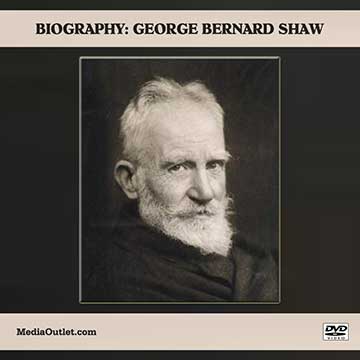
( #JCKaelin: The modern phenomenon of
"Democratic Socialism" has deeper roots and a more elite
pedigree than you might imagine! ) ========= January 4, 1884:
Foundings: -- Social Democracy (Democratic Socialism):
Progressivism: Progressivism In The United Kingdom: Think Tanks:
Think Tanks Based In The United Kingdom: Socialist Think Tanks
Based In The United Kingdom: The Fabian Society: -- Nine men and
women -- Frank Podmore, Edward R. Pease, William Clarke, Hubert
Bland, Percival Chubb, Frederick Keddell, H. H. Champion, Edith
Nesbit, and Rosamund Dale Owen (Havelock Ellis is sometimes also
mentioned as a tenth founding member, though there is some
question about this) meet at 17 Osnaburgh Street, London, England
to founded The Fabian Society, a British socialist organisation
whose purpose continues to be to advance the principles of
democratic socialism via gradualist and reformist effort in
democracies, rather than by revolutionary overthrow. Immediately
upon its inception, the Fabian Society began attracting many
prominent contemporary figures drawn to its socialist cause,
including George Bernard Shaw, H. G. Wells, Annie Besant, Graham
Wallas, Charles Marson, Sydney Olivier, Oliver Lodge, Ramsay
MacDonald and Emmeline Pankhurst. Even Bertrand Russell briefly
became a member, but resigned after he expressed his belief that
the Society's principle of entente (in this case, between
countries allying themselves against Germany) could lead to war.
As one of the founding organisations of the Labour Representation
Committee in 1900, and as an important influence upon the Labour
Party which grew from it, the Fabian Society has had a powerful
influence on British politics. Other members of the Fabian Society
have included political leaders from countries formerly part of
the British Empire, such as: Jawaharlal Nehru, who adopted Fabian
principles as part of their own political ideologies. The Fabian
Society founded the London School of Economics and Political
Science in 1895 "for the betterment of society". Today,
the society functions primarily as a think tank and is one of 15
socialist societies affiliated with the Labour Party. On Sale @
15% Off Discount Till Midnight PT!
https://store.earthstation1.com/george-bernard-shaw-dvd-biography-documentary.html
Today's
EarthStation1.com 15% Off Commemorative Memorial Title: France:
Conquest To Liberation + French WWII Female Spies MP4 Or DVD
Today, January 4, 2026
January 4, 1944: The European Civil War:
World War II: The Second European War (The European Theater Of
World War II): Resistance During World War II: World War II
Resistance Movements: Operation Carpetbagger: -- The U.S. Army Air
Forces implements Operation Carpetbagger, a World War II operation
to provide aerial supply of weapons and other materiel to
resistance fighters in France, Italy and the Low Countries of
Europe, who were continually supplied thereafter by RAF and USAAF
air drops throughout the remainder of World War II. The first
Carpetbagger missions were carried out by General William J.
Donovan aka "Wild Bill" Donovan's Office of Strategic
Services (OSS). In late 1943, the 22d Antisubmarine Squadron of
the Eighth Air Force was disbanded at RAF Alconbury and its
aircraft used to form the 36th and 406th Bombardment Squadrons
under the 482nd bomb group. After some shuffling of commands,
these two squadrons were placed under the provisional 801st Bomb
Group at RAF Harrington at the beginning of 1944 and the first
"Carpetbagger" missions were carried out by this unit
under the control of General "Wild Bill" Donovan's
Office of Strategic Services (OSS). In April 1944, the group moved
to RAF Harrington (Station 179), a more secluded and thus more
secure airbase. A month later, in advance of the expected invasion
of Europe, it was expanded to four squadrons to increase its
capabilities and to pick up workload from RAF Bomber Command; the
two new squadrons were the 788th and 850th Bombardment Squadrons.
The Group had already adopted the nickname of "Carpetbaggers"
from its original operational codename. In August 1944, the group
dropped the "Provisional" status and absorbed the names
of the 492d Bombardment Group from RAF North Pickenham, which had
stood down after severe losses in its initial operations but
stayed at Harrington; its squadrons became the 856th, 857th, 858th
and 859th Bomb Squadrons. From January 1944 to the end of the war,
the Group, in liaison with the British Special Operations
Executive and later the Special Forces Headquarters (SFHQ) in
London, dropped spies and supplies to the resistance forces of
France, Belgium, the Netherlands, Denmark and Norway. During a
hiatus in operations from mid-September 1944 to the end of 1944,
the Group ferried gasoline to depots on the Continent for two
weeks to supply advancing Allied armies, then three squadrons went
into training for night bombing operations, whilst the 856th
participated in the return of Allied airmen on the Continent who
had either evaded capture or had walked out of Switzerland after
that country relaxed its internment practices. This exercise was
carried out mostly in Douglas C-47 Skytrains assigned to the group
originally for insertion operations during the previous summer. In
December 1944, the 859th was sent on Detached Service with the
Fifteenth Air Force in the Mediterranean Theater of Operations
with the 2641st Special Group (Provisional) at Brindisi, Italy.
The 856th Bomb Squadron, after completing the personnel recovery
mission, resumed Carpetbagger operations on a limited basis during
the bad weather of the winter of 1945, while the remaining two
squadrons (the 857th and 858th) participated in medium altitude
bombing from late December 1944 through March 1945. In the spring
of 1945, Carpetbagger operations resumed but not to the extent of
the previous year. The 857th was detached and sent to RAF
Bassingbourn (91st Bomb Group) at the end of March 1945, while the
856th and 858th dropped small numbers of agents and sabotage teams
into the Netherlands, Denmark, Norway and Germany. Operations came
to an end at Harrington at the end of April 1945, though a few
special OSS missions, such as returning dignitaries to formerly
occupied countries, carried on until the Group disbanded and
returned to the United States in early July 1945. The B-24
Liberator bombers used for the flights were modified by removing
the belly turret, nose guns and any equipment unnecessary for the
mission, such as oxygen equipment, in order to lighten them and
provide more cargo space and speed. The rear guns were kept as
protection from night fighters. Agents and crated supplies were
dropped by parachute through the opening left by removal of the
belly turret. In addition, supplies were loaded into containers
designed to fit inside the bomb-bay and released from there by the
existing equipment. Targets were given by exact longitudes and
latitudes, thus making precise navigation imperative. All flights
were made on moonlit nights so that visual navigation could be
made by using rivers, lakes, railroad tracks, and towns as check
points. The pilot, copilot, and bombardier all had maps to aid
them in keeping track of their location, whilst the navigator kept
position by dead reckoning, with all four of these officers
staying in close interphone contact. All flights were individual,
each navigator choosing his route in consultation with the pilot.
On flights to French targets the aircraft crossed the coast at
around 6,000 feet (1,800_m) to avoid light anti-aircraft fire,
dropping to 500 feet (150_m) or so to avoid night fighters once
inland and to make it possible to verify location, assuring that
checkpoints on the ground corresponded exactly to the area being
looked at in the cockpit and nose of the aircraft. Limited
visibility at higher altitude would make this more difficult if
not impossible. Since drops were made at 400-500 feet (120-150_m)
at the pilot's discretion, being already at such a height made the
drops more efficient. When only a few miles from the target area
all available eyes began searching for the drop area, which would
usually be identified by three high powered flashlights placed in
a row, with a fourth at a 90 degree angle to indicate the
direction of the drop. Coming towards the target, the aircraft
slowed to between 120-125 miles per hour (190-200_km/h) and
dropped to an altitude of 400 feet (120_m), higher in hilly
country: agents were dropped first, with supplies on a second
drop. Often, pilots had to fly several miles farther into enemy
territory after completing their drops to disguise the actual drop
location should any enemy observers recognize the aircraft's
turning point as the drop location. In some cases multiple drops
in isolated areas were made at different intervals and bonfires
would be used as drop indicators instead of flashlights. In rare
cases air to ground oral radio contact would be made, these being
of great importance. The group has been generally recognized as
the ancestor of today's Air Force Special Operations. On Sale @
15% Off Discount Till Midnight PT!
https://store.earthstation1.com/france-conquest-to-liberation-occupied-and-vichy-wwii.html
Today's
EarthStation1.com 15% Off Commemorative Memorial Title: The Hardly
Worthit Report Faux Huntley-Brinkley MP3 CD, Download, USB
Today, January 4, 2026
January 4, 1896: #BOTD: #HBD! Everett
Dirksen, American liberal republican politician, representative
and senator from Illinois, Senate Minority Leader from 1959 until
his death in 1969 who played a highly visible and key role in the
politics of the 1960s (d. September 7, 1969) is #born Everett
McKinley Dirksen in Pekin, Illinois, a small city near Peoria. He
helped write and pass the Civil Rights Act Of 1964 and the Civil
Rights Act Of 1968, both landmark pieces of legislation during the
civil rights movement. He was also one of the Senate's strongest
supporters of the Vietnam War. A talented orator with a florid
style and a notably rich baritone voice, he delivered flamboyant
speeches that caused his detractors to refer to him as "The
Wizard of Ooze". Dirksen served as an artillery officer
during World War I and opened a bakery after the war. After
serving on the Pekin City Council, he won election to the House of
Representatives in 1932. In the House, he was considered a
moderate and supported much of the New Deal; he became more
conservative and isolationist over time, but reversed himself to
support US involvement in World War II. He won election to the
Senate in 1950, unseating Senate Majority Leader Scott W. Lucas.
In the Senate, he favored conservative economic policies and
supported the internationalism of President Dwight D. Eisenhower.
Dirksen succeeded William F. Knowland as Senate Minority Leader
after the latter declined to seek re-election in 1958. As the
Senate Minority Leader, Dirksen emerged as a prominent national
figure of the Republican Party during the 1960s. He developed a
good working relationship with Senate Majority Leader Mike
Mansfield and supported President Lyndon B. Johnson's handling of
the Vietnam War. He helped break the Southern filibuster of the
Civil Rights Act Of 1964. Everett Dirksen died while still serving
as Senate Minority Leader of cardiopulmonary arrest after lung
cancer surgery caused bronchopneumonia at Walter Reed Army
Hospital, aged 73. Dirksen lay in state at the United States
Capitol rotunda, followed by burial at Glendale Memorial Gardens
in his hometown of Pekin, Illinois. The Dirksen Senate Office
Building is named after him. On Sale @ 15% Off Discount Till
Midnight PT!
https://store.earthstation1.com/the-hardly-worthit-report-comedy-lp-mp3-cd-1966-huntleybri31966.html
Today's
EarthStation1.com 15% Off Commemorative Memorial Title: CIA The
Secret Files The Central Intelligence Agency TV Series MP4 DVD
Today, January 4, 2026
January 4, 1920: #BOTD: William Colby,
American intelligence officer, 10th Director of Central
Intelligence (d. May 6, 1996) is #born William Egan Colby in Saint
Paul, Minnesota. William Colby spent a career in intelligence for
the United States, culminating in holding the post of the Director
of Central Intelligence (DCI) from September 1973 to January 1976.
During World War II Colby served with the Office of Strategic
Services. After the war he joined the newly created Central
Intelligence Agency (CIA). Before and during the Vietnam War,
Colby served as chief of station in Saigon, chief of the CIA's Far
East Division, and head of the Civil Operations and Rural
Development effort, as well as overseeing the Phoenix Program.
After Vietnam, Colby became director of central intelligence and
during his tenure, under intense pressure from the United States
Congress and the media, adopted a policy of relative openness
about U.S. intelligence activities to the Senate Church Committee
and House Pike Committee. Colby served as DCI under President
Richard Nixon and President Gerald Ford and was replaced with
future president George H. W. Bush on January 30, 1976. On April
27, 1996, Colby set out from his weekend home in Rock Point,
Maryland on a solo canoe trip. His canoe was found the following
day on a sandbar in the Wicomico River, a tributary of the
Potomac, approximately a quarter mile from his home. On May 6,
Colby's body was found in a marshy riverbank lying facedown not
far from where his canoe was found. After an autopsy, Maryland's
Chief Medical Examiner John E. Smialek ruled his death to be
accidental. Smialek's report noted that Colby was predisposed to
having a heart attack or stroke due to "severe calcified
atherosclerosis" and that Colby likely "suffered a
complication of this atherosclerosis which precipitated him into
the cold water in a debilitated state and he succumbed to the
effects of hypothermia and drowned". He is buried at
Arlington National Cemetery in Arlington, Virginia. Colby's death
triggered speculation that his death was due to foul play or
suicide. In his 2011 documentary The Man Nobody Knew, Colby's son
Carl suggested that his father suffered from guilt due to his
actions in the CIA and committed suicide. Carl's step-mother and
siblings, as well as Colby' biographer Randall Woods, criticized
Carl's portrayal of William Colby, and rejected the allegation
that the former CIA director killed himself, citing it as being
inconsistent with his character. Despite such attestations, Carl
said to John Meroney and Sean Coons of Atlantic Magazine "I
remember calling to inform him (his father) that one of his
Princeton roommates was found wandering under a bridge in
Middlebury, Vermont, with advanced Alzheimer's. 'Oh, that will
never happen to me,' he said. 'Really?,' I asked. 'Nope. One day
you'll hear that I was walking along a goat path on a Greek island
and I fell into the sea.'; I said, again, 'Really?' And he
replied, 'Yep. That's it.'" On Sale @ 15% Off Discount Till
Midnight PT!
https://store.earthstation1.com/cia-the-secret-files-the-central-intelligence-agency-tv-series-mp4-dv4.html
Today's
EarthStation1.com 15% Off Commemorative Memorial Title: The Doors:
The Doors Are Open! Live Concerts MP4 Video Download DVD
Today, January 4, 2026
January 4, 1967: Record Releases: -- The
Doors, the debut studio album by American rock band the Doors, is
released. It was recorded in August 1966 at Sunset Sound
Recorders, Hollywood, California, under the production of Paul A.
Rothchild. Since its release, the record has been often regarded
as one of the greatest debut albums of all time, by both music
critics and publishers. It features the long version of the
breakthrough single "Light My Fire" and the lengthy song
"The End" with its Oedipal spoken word section. The
Doors were working the material of their debut album throughout
the year of 1966 at the Whisky a Go Go. The album's recording
started after their dismissal from the venue, under the
maintenance of Elektra Records. The recording of The Doors
established the band's large extensive number of musical
influences, such as jazz, classical, blues, pop, R & B and
rock music. It has been viewed as an essential part of the
psychedelic rock evolution, while also being acknowledged as a
source of inspiration to other works. The Doors and "Light My
Fire" have been inducted into the Grammy Hall of Fame. In
2015 the Library of Congress selected The Doors for inclusion in
the National Recording Registry based on its cultural, artistic or
historical significance. The Doors remains the band's best-selling
studio album, with sales of over 13 million copies, as of 2015. On
Sale @ 15% Off Discount Till Midnight PT!
https://store.earthstation1.com/the-doors-the-doors-are-open-live-london-rock-concert-dvd.html
Today's
EarthStation1.com 15% Off Commemorative Memorial Title: Allied
Codebreakers Of WWI & WWII DVD MP4 Video Download USB Drive
Today, January 4, 2026
January 4, 1923: #BOTD: #HBD! Ronnie
Hulick, one of three hundred United States Naval Women's Reserve
(W.A.V.E.S.) in Dayton, Ohio who worked during World War II on the
machines used to decipher the enemy's secret codes (d. Monday,
April 11, 2016) is #born Veronica Hulick in Wilmington, Delaware.
She joined the WAVES after graduating from P.S. DuPont High
School. Historians say that her efforts and those of her
colleagues helped shorten the war by at least two years, and led
to the sinking of 750 enemy submarines. After the war, she
attended George Washington University and later graduated from
Temple University in Philadelphia where she completed the dental
hygienist program in 1948. Mrs. Hulick moved to Washington DC area
where she raised her children and worked for area dentists until
she retired and moved to Fort Pierce, Florida in 1987. She was
active in local singing groups, including the Nostalgia Follies.
Her last performance was on St. Patrick's Day at the Lynmoore
assisted living facility. She was a member of St. Mark's the
Evangelist Church. Ronnie Hulick died at Port St. Lucie Nursing
and Restorative Care Center at the age of 93. A Mass of Christian
Burial was held at 11:00 am on Monday, April 18, 2016 at St. Marks
Catholic Church, 1924 Zephyr Avenue, Fort Pierce, FL. An inurnment
ceremony was later held at Arlington National Cemetery. On Sale @
15% Off Discount Till Midnight PT!
https://store.earthstation1.com/allied-codebreakers-of-wwi-amp-wwii-dvd-mp4-video-download-usb-driv4.html
Today's
EarthStation1.com 15% Off Commemorative Memorial Title: LBJ 1991
TV Documentary Series Lyndon Johnson DVD Download USB Drive
Today, January 4, 2026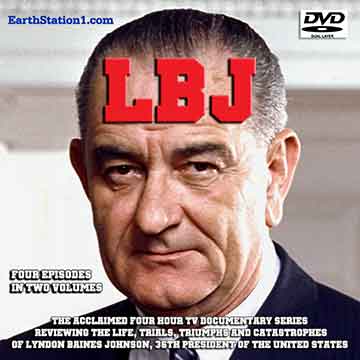
January 4, 1943: #BOTD: #HBD! Doris
Kearns Goodwin, American biographer, historian, author and
political commentator, is #born Doris Helen Kearns Goodwin in
Brooklyn, New York. She has authored biographies of several U.S.
presidents, including Lyndon Johnson and the American Dream; The
Fitzgeralds and the Kennedys: An American Saga; No Ordinary Time:
Franklin and Eleanor Roosevelt: The Home Front in World War II
(which won the Pulitzer Prize for History in 1995); Team of
Rivals: The Political Genius of Abraham Lincoln; and her most
recent book, The Bully Pulpit: Theodore Roosevelt, William Howard
Taft, and the Golden Age of Journalism. She also appears in a
number of documentaries of historical subjects within her ken,
including "Peace In Our Time" about the 1938 Munich
Agreement. On Sale @ 15% Off Discount Till Midnight PT!
https://store.earthstation1.com/lbj-1991-tv-documentary-series-lyndon-johnson-dvd-download-usb-d1991.html
Today's
EarthStation1.com 15% Off Commemorative Memorial Title: New York
City History Documentary Collection MP4 Video Download DVD
Today, January 4, 2026
January 4, 1985: Aesthetics: Performing
Arts: Finales: Theatre Finales: Musical Finales: Opera Finales: --
Leontyne Price, African American operatic soprano, makes her
farewell appearance with the Metropolitan Opera singing the title
role of Aida. Leontyne Price was born Mary Violet Leontyne Price
in Laurel, Mississippi, where she was raised. She rose to
international acclaim in the 1950s and 1960s, and was the first
African American to become a leading performer at the Metropolitan
Opera, and one of the most popular American classical singers of
her generation. Reviewing her televised farewell opera performance
at the Met in 1985, as Aida, one critic described Price's voice as
"vibrant," "soaring" and "a Price beyond
pearls." Time magazine called her voice "Rich, supple
and shining, it was in its prime capable of effortless soaring
from a smoky mezzo to the pure soprano gold of a perfectly spun
high C." A lirico spinto (Italian for "pushed lyric")
soprano, she was considered especially well suited to the heroines
of Verdi's "middle period" operas: Aida, the Leonoras of
Il trovatore and La forza del destino. and Amelia in Un ballo in
maschera. She also was noted for her interpretations of leading
roles in operas by Giacomo Puccini and Wolfgang Amadeus Mozart.
After her retirement from opera, she continued to appear in
recitals and orchestral concerts until 1997. Among her many honors
and awards are the Presidential Medal Of Freedom (1964), the
Spingarn Medal (1965), the Kennedy Center Honors (1980), the
National Medal of Arts (1985), the Golden Plate Award of the
American Academy of Achievement (1986), numerous honorary degrees,
and 19 Grammy Awards for operatic and song recitals and full
operas, and a Lifetime Achievement Award, more than any other
classical singer. In October 2008, she was among the first
recipients of the Opera Honors by the National Endowment for the
Arts. In 2019, Leontyne Price was awarded an honorary doctorate
degree from Boston Conservatory at Berklee. At the age of 14, she
was taken on a school trip to hear Marian Anderson sing a recital
in Jackson, an experience she later said was inspirational. "The
minute she came on stage, I knew I wanted to walk like that, look
like that, and if possible, sound something near that," she
told an interviewer in 2008. On Sale @ 15% Off Discount Till
Midnight PT!
https://store.earthstation1.com/new-york-city-history-videos-3-dvd-se3.html
Today's
EarthStation1.com #OnThisDay Commemorative Memorial Title: The
Race For Space 1961 Historic Soviet Space Films DVD, Download, USB
Today, January 4, 2026 January 4, 1958: The History Of
Spaceflight: The Cold War: The Space Age: The Space Race: The
Soviet Space Program: Earth Satellites: The Sputnik Program
(Sputnik Spacecraft): Sputnik 1 (Russian: "Satellite-1";
Prosteyshiy Sputnik-1 or PS-1, "Elementary Satellite 1,
Sputnik I): -- Sputnik 1, the first man-made satellite, falls to
Earth when its orbit decayed caused by aerodynamic drag and burns
up in the earth's atmosphere, after three months in space, 1,440
completed orbits of the Earth, and a distance traveled of about
70,000,000_km (43,000,000_mi). On October 4, 1957, the Space Age
began as the Soviet Union launched Sputnik 1 ("Satellite-1",
or "PS-1", Prosteyshiy Sputnik-1, "Elementary
Satellite 1") into Earth orbit. Sputnik I weighed just 184
lbs. and transmitted a beeping radio signal for 21 days. The
Soviet Union launched it into an elliptical low Earth orbit. It
was a 58 cm (23 in) diameter polished metal sphere, with four
external radio antennas to broadcast radio pulses. It was visible
all around the Earth, and its radio pulses were detectable. This
surprise success precipitated the American Sputnik crisis and
triggered the Space Race, a part of the Cold War. The launch
ushered in new political, military, technological, and scientific
developments. Tracking and studying Sputnik 1 from Earth provided
scientists with valuable information, even though the satellite
itself wasn't equipped with sensors. The density of the upper
atmosphere could be deduced from its drag on the orbit, and the
propagation of its radio signals gave information about the
ionosphere. Sputnik 1 was launched during the International
Geophysical Year from Site No.1/5, at the 5th Tyuratam range, in
Kazakh SSR (now known as the Baikonur Cosmodrome). The satellite
travelled at about 29,000 kilometres per hour (18,000 mph; 8,100
m/s), taking 96.2 minutes to complete each orbit. It transmitted
on 20.005 and 40.002 MHz, which were monitored by amateur radio
operators throughout the world. The signals continued for until
the transmitter batteries ran out on 26 October 1957. Sputnik
burned up on 4 January 1958 while reentering Earth's atmosphere,
after three months, 1440 completed orbits of the Earth, and a
distance travelled of about 70 million km (43 million mi). The
Soviet accomplishment sent a shockwave through the American
political leadership resulting in U.S. efforts to be the first on
the moon.
https://store.earthstation1.com/the-race-for-space-dvd-1961-secret-soviet-f1961.html
January 4, 1958: The History Of
Spaceflight: The Cold War: The Space Age: The Space Race: The
Soviet Space Program: Earth Satellites: The Sputnik Program
(Sputnik Spacecraft): Sputnik 1 (Russian: "Satellite-1";
Prosteyshiy Sputnik-1 or PS-1, "Elementary Satellite 1,
Sputnik I): -- Sputnik 1, the first man-made satellite, falls to
Earth when its orbit decayed caused by aerodynamic drag and burns
up in the earth's atmosphere, after three months in space, 1,440
completed orbits of the Earth, and a distance traveled of about
70,000,000_km (43,000,000_mi). On October 4, 1957, the Space Age
began as the Soviet Union launched Sputnik 1 ("Satellite-1",
or "PS-1", Prosteyshiy Sputnik-1, "Elementary
Satellite 1") into Earth orbit. Sputnik I weighed just 184
lbs. and transmitted a beeping radio signal for 21 days. The
Soviet Union launched it into an elliptical low Earth orbit. It
was a 58 cm (23 in) diameter polished metal sphere, with four
external radio antennas to broadcast radio pulses. It was visible
all around the Earth, and its radio pulses were detectable. This
surprise success precipitated the American Sputnik crisis and
triggered the Space Race, a part of the Cold War. The launch
ushered in new political, military, technological, and scientific
developments. Tracking and studying Sputnik 1 from Earth provided
scientists with valuable information, even though the satellite
itself wasn't equipped with sensors. The density of the upper
atmosphere could be deduced from its drag on the orbit, and the
propagation of its radio signals gave information about the
ionosphere. Sputnik 1 was launched during the International
Geophysical Year from Site No.1/5, at the 5th Tyuratam range, in
Kazakh SSR (now known as the Baikonur Cosmodrome). The satellite
travelled at about 29,000 kilometres per hour (18,000 mph; 8,100
m/s), taking 96.2 minutes to complete each orbit. It transmitted
on 20.005 and 40.002 MHz, which were monitored by amateur radio
operators throughout the world. The signals continued for until
the transmitter batteries ran out on 26 October 1957. Sputnik
burned up on 4 January 1958 while reentering Earth's atmosphere,
after three months, 1440 completed orbits of the Earth, and a
distance travelled of about 70 million km (43 million mi). The
Soviet accomplishment sent a shockwave through the American
political leadership resulting in U.S. efforts to be the first on
the moon.
https://store.earthstation1.com/the-race-for-space-dvd-1961-secret-soviet-f1961.html
Today's
EarthStation1.com #OnThisDay Commemorative Memorial Title:
American Lifestyle Famous Americans TV Series DVD, Download, USB
Drive
Today, January 4, 2026January 4, 1877: #DOTD: #RIP: Cornelius
Vanderbilt, also known informally as "Commodore Vanderbilt",
American business magnate and philanthropist (b. May 27, 1794)
#dies at his residence, No. 10 Washington Place, Manhattan, New
York, after having been confined to his rooms for about eight
months. The immediate cause of his death was exhaustion, brought
on by long suffering from a complication of chronic disorders. At
the time of his death, aged 82, Vanderbilt had an estimated worth
of 105M USD million. He is buried at the Vanderbilt Family
Cemetery and Mausoleum, Staten Island, New York. Born poor and
having only a mediocre education, Vanderbilt used perseverance,
intelligence, and luck to work his way into leadership positions
in the inland water trade and invest in the rapidly growing
railroad industry. He built his wealth in railroads and shipping.
He is known for owning the New York Central Railroad. As one of
the richest Americans in history and wealthiest figures overall,
Vanderbilt was the patriarch of a wealthy, influential family. He
provided the initial gift to found Vanderbilt University in
Nashville, Tennessee. Contemporaries hated or feared Vanderbilt,
considering him an unmannered brute; while he could be a rascal,
combative and cunning, he was more a builder than a wrecker, being
honorable, shrewd, and hard-working.
https://store.earthstation1.com/american-lifestyle-famous-americans-tv-series-2-dual-layer-dvd2.html
Today's
EarthStation1.com #OnThisDay Commemorative Memorial Title:
Muhammad Ali Documentaries And Entire Fights DVD, Download, USB
Drive
Today, January 4, 2026January 4, 1935: #BOTD: #HBD! Floyd
Patterson, African American professional boxer and actor (d. May
11, 2006) is #born into a poor family in Waco, North Carolina, one
of eleven children. Floyd Patterson twice reigned as the world
heavyweight champion between 1956 and 1962 and competed from 1952
to 1972. At the age of 21, he became the youngest boxer in history
to win the title of Heavyweight Champion Of The World, and was
also the first heavyweight to regain the title after losing it. As
an amateur, he won a gold medal in the middleweight division at
the 1952 Summer Olympics. In 1956 and 1960, Patterson was voted
Fighter of the Year by The Ring magazine and the Boxing Writers
Association of America. He was inducted into the International
Boxing Hall of Fame in 1991.
https://store.earthstation1.com/muhammad-ali--dvd-2-discs-documentaries-and-entire-fight2.html
Today's
EarthStation1.com #OnThisDay Commemorative Memorial Title: Scouts!
Lord Baden-Powell & The Boy Scouts DVD MP4 Download USB Stick
Today, January 4, 2026January 4, 1912: Scouting (The Scout
Movement): Royal Charters: The Boy Scouts Association: -- King
George V Of England issues a royal charter that incorporates The
Boy Scouts Association (now known as The Scout Association)
throughout the British Empire. The Scout Association is the
largest Scouting organisation in the United Kingdom and is the
World Organization of the Scout Movement's recognised member for
the United Kingdom. Following the origin of Scouting in 1907, the
association was formed in 1910 and incorporated in 1912 by a royal
charter. The Scout Movement, originally known as The Boy Scouts,
also known as Scouting or the Scouts, is a voluntary non-political
educational movement for young people. Although it requires an
oath of allegiance to a nation's leaders and, in some countries,
to a god, it otherwise allows membership without distinction of
gender, race or origin in accordance with the principles of its
founder, Lord Baden-Powell. The purpose of the Scout Movement is
to contribute to the development of young people in achieving
their full physical, intellectual, emotional, social and spiritual
potentials as individuals, as responsible citizens and as members
of their local, national and international communities. During the
first half of the twentieth century, the movement grew to
encompass three major age groups for boys: Cub Scout, Boy Scout
and Rover Scout. In 1910, the Girl Guides was created,
encompassing three major age groups for girls: Brownie Guide, Girl
Guide and Girl Scout and Ranger Guide. It is one of several
worldwide youth organizations. In 1906 and 1907 Robert
Baden-Powell, a lieutenant general in the British Army, wrote a
book for boys about reconnaissance and scouting. This book,
Scouting for Boys, was based on his earlier books about military
scouting, with influence and support of Frederick Russell Burnham
(Chief of Scouts in British Africa), Ernest Thompson Seton of the
Woodcraft Indians, William Alexander Smith of the Boys' Brigade,
and his publisher Pearson. In mid-1907 Baden-Powell held a camp on
Brownsea Island in England to test ideas from his book. This camp
and the publication of Scouting for Boys (London, 1908) are
generally regarded as the start of the Scout movement. The
movement employs the Scout method, a programme of informal
education with an emphasis on practical outdoor activities,
including camping, woodcraft, aquatics, hiking, backpacking, and
sports. Another widely recognized movement characteristic is the
Scout uniform, by intent hiding all differences of social standing
in a country and making for equality, with neckerchief and
campaign hat or comparable headwear. Distinctive uniform insignia
include the fleur-de-lis and the trefoil, as well as badges and
other patches. The two largest umbrella organizations are the
World Organization of the Scout Movement (WOSM), for boys-only and
co-educational organizations, and the World Association of Girl
Guides and Girl Scouts (WAGGGS), primarily for girls-only
organizations but also accepting co-educational organizations. The
year 2007 marked the centenary of Scouting worldwide, and member
organizations planned events to celebrate the occasion.
https://store.earthstation1.com/scouts-the-life-and-legacy-of-lord-badenpowell-dvd-mp4-us4.html
Today's
EarthStation1.com #OnThisDay Commemorative Memorial Title: Native
North American Indian History Documentaries MP4 Downloads DVDs
Today, January 4, 2026January 4, 1999: #DOTD: #RIP: Iron Eyes
Cody, Italian-American actor and stuntman who portrayed Native
Americans in Hollywood films, who famously played a Native
American shedding a tear about litter in one of the country's most
well-known television public service announcements, "Keep
America Beautiful" (b. April 3, 1907) #dies at the age of 94
from mesothelioma at home in Los Angeles, aged 94. Before death,
he had written this comment, inspired by an old Native American
prayer: "Make me ready to stand before you with clean and
straight eyes. When life fades, as the fading sunset, may our
spirits stand before you without shame." He is buried in The
Hollywood Forever cemetery in Hollywood, California. Iron Eyes
Cody was born Espera Oscar de Corti in Kaplan, Louisiana, the
second son of Francesca Salpietra from Sicily and her husband
Antonio de Corti from southern Italy; in 1996, Cody's half-sister
said in a story by The Times-Picayune in New Orleans that he was
of Italian ancestry, but Cody, who by this time wore his Hollywood
costumes in daily life, denied it. Cody began acting in the early
1930s. He worked in film and television until his death. Cody
claimed his father was Cherokee (and his mother Cree), also naming
several different tribes, and frequently changing his claimed
place of birth. To those unfamiliar with Indigenous American or
First Nations cultures and people, he apparently gave the
appearance of living "as if" he were Native American,
fulfilling the stereotypical expectations by wearing his film
wardrobe as daily clothing - including braided wig, fringed
leathers and beaded moccasins - at least when photographers were
visiting, and in other ways continuing to play the same
Hollywood-scripted roles off-screen as well as on. A close friend
of Walt Disney, Cody appeared in a Disney studio serial titled The
First Americans, and in episodes of The Mountain Man, Davy
Crockett and Daniel Boone. He also appeared in a 1968 episode of
Mister Rogers' Neighborhood featuring Native American dancers.
Cody was widely seen as the "Crying Indian" in the "Keep
America Beautiful" public service announcements (PSA) in the
early 1970s.The environmental commercial showed Cody dressed as a
Native American, shedding a tear after trash is thrown from the
window of a car and it lands at his feet. The announcer, William
Conrad, says: "People start pollution; people can stop it.".
The Joni Mitchell song "Lakota," from the 1988 album,
Chalk Mark in a Rainstorm, features Cody's chanting. In 1936, Cody
married Bertha Parker. She was active in excavations during the
late 1920s and early 1930s before becoming an assistant in
archaeology at the Southwest Museum. They adopted two children
said to be of Dakota-Maricopa origin, Robert Tree Cody and Arthur.
The couple remained married until Bertha's death in 1978. Bertha
"Birdie" Parker Pallan was the first Native American
female archaeologist, of Abenaki and Seneca descent. Her father,
Arthur C. Parker, was an archaeologist and the first president of
the Society for American Archaeology. As a child, she assisted her
father in his excavations. In 1914 she relocated with her mother
to Los Angeles to work in Hollywood films. Bertha and her mother
also performed with Ringling Bros. and Barnum and Bailey Circus as
part of a "Pocahontas" show during her teenage years. In
1925 she moved to Nevada to work on an archaeological site for the
Southwest Museum, directed by Mark Raymond Harrington. She
eventually got a steady job as archaeologist and ethnologist for
the Southwest Museum. In 1936, she married the actor Iron Eyes
Cody. Bertha and Iron Eyes were central figures in the success of
the Los Angeles Indian Center, a gathering place for urban Indians
relocated to Los Angeles. Bertha Parker Pallan died in 1978, aged
71. Her gravestone simply reads "Mrs. Iron Eyes Cody".
https://store.earthstation1.com/native-north-american-indian-history-documentaries-dvd-mp4-us4.html
Today's
EarthStation1.com #OnThisDay Commemorative Memorial Title: Parrot
Sketch Not Included: The Very Best Of Monty Python DVD MP4 USB
Today, January 4, 2026January 4, 1941: #DOTD: #RIP: Henri
Bergson, French philosopher and theologian, Nobel Prize laureate
(b. October 18, 1859) #dies in occupied Paris, the city of his
birth, from bronchitis, aged 81. A Roman Catholic priest said
prayers at his funeral per his request. Bergson is buried in the
Cimetiere de Garches, Hauts-de-Seine. Born Henri-Louis Bergson, he
was influential in the tradition of continental philosophy, a set
of 19th- and 20th-century philosophical traditions from mainland
Europe, especially during the first half of the 20th century until
the Second World War. Bergson is known for his arguments that
processes of immediate experience and intuition are more
significant than abstract rationalism and science for
understanding reality. He was awarded the 1927 Nobel Prize in
Literature "in recognition of his rich and vitalizing ideas
and the brilliant skill with which they have been presented".
In 1930 France awarded him its highest honour, the Grand-Croix de
la Legion d'honneur. Bergson's great popularity created a
controversy in France where his views were seen as opposing the
secular and scientific attitude adopted by the Republic's
officials. Bergson's sister, Mina Bergson (also known as Moina
Mathers), married the English occult author Samuel Liddell
MacGregor Mathers, a founder of the Hermetic Order of the Golden
Dawn. Henri Bergson is frequently mentioned in the comedy sketches
of Monty Python's Flying Circus.
https://store.earthstation1.com/parrot-sketch-not-included-very-best-of-monty-python-dvd-mp4-us4.html
Today's
EarthStation1.com #OnThisDay Commemorative Memorial Title: T. S.
Eliot Documentary Biography DVD, Video Download, USB Flash Drive
Today, January 4, 2026January 4, 1965: #DOTD: #RIP: T. S.
Eliot, American-English poet, playwright, and critic, Nobel Prize
laureate (b. September 26, 1888) #dies of emphysema at his home in
Kensington in London, aged 76, and was cremated at Golders Green
Crematorium. In accordance with his wishes, his ashes were taken
to St Michael and All Angels' Church, East Coker, the village in
Somerset from which his Eliot ancestors had emigrated to America.
A wall plaque in the church commemorates him with a quotation from
his poem East Coker: "In my beginning is my end. In my end is
my beginning.. Thomas Stearns Eliot was a British essayist,
publisher, playwright, literary and social critic, and "one
of the twentieth century's major poets". He moved from his
native United States to England in 1914 at the age of 25,
settling, working, and marrying there. He eventually became a
British subject in 1927 at the age of 39, renouncing his American
citizenship. Eliot attracted widespread attention for his poem
"The Love Song of J. Alfred Prufrock" (1915), which was
seen as a masterpiece of the Modernist movement. It was followed
by some of the best-known poems in the English language, including
The Waste Land (1922), "The Hollow Men" (1925), "Ash
Wednesday" (1930), and Four Quartets (1943). He was also
known for his seven plays, particularly Murder in the Cathedral
(1935) and The Cocktail Party (1949). He was awarded the Nobel
Prize in Literature in 1948, "for his outstanding, pioneer
contribution to present-day poetry.".
https://store.earthstation1.com/t-s-eliot-dvd-biography-poetry-literature.html
Today's
EarthStation1.com #OnThisDay Commemorative Memorial Title: Thomas
A. Edison: The Wizard Of Menlo Park DVD, Download, USB Drive
Today, January 4, 2026January 4, 1903: #DOTD: #RIP: Topsy,
female Asian elephant, infamously electrocuted at Coney Island,
New York (b. c. 1875) #dies when she is electrocuted by the owners
of Luna Park, Coney Island. The Edison film company shoots the
film "Electrocuting An Elephant" of Topsy' death. After
several incidents at Luna Park (sometimes attributed to the
actions of her drunken handler, William "Whitey" Alt)
the owners of Luna Park, Frederick Thompson and Elmer Dundy,
claimed they could no longer handle the elephant and announced
they would hang Topsy in a public spectacle and charge admission.
The American Society for the Prevention of Cruelty to Animals
stepped in, questioning the idea of hanging an elephant as well as
making a public spectacle out of the death of an animal. Thompson
and Dundy cut the event back to invited guest and press only and
agreed to use a more sure method of strangling the elephant with
large ropes tied to a steam powered winch. They also agreed they
would use poison and electricity as well. In popular culture
Thompson and Dundy' execution of Topsy has switched attribution,
with claims the film depicts an anti-alternating current
demonstration organized by Thomas A. Edison during the War of
Currents. Historians point out that Edison was never at Luna Park
and the electrocution of Topsy took place 10 years after the War
of Currents.
https://store.earthstation1.com/thomas-a-edison-the-wizard-of-menlo-park-dvd.html
Today's
EarthStation1.com #OnThisDay Commemorative Memorial Title: Korea:
The Unknown War TV Korean War Series DVD, Download, USB Drive
Today, January 4, 2026January 4, 1951: The Cold War: The Korean
Conflict: The Korean War: The Third Battle Of Seoul (The Chinese
New Year's Offensive, The January-Fourth Retreat [Korean: 1/4
Hutoe, "The 1/4 Retreat"] The Third Phase Campaign
Western Sector: -- Chinese and North Korean forces capture Seoul.
The Third Battle Of Seoul, also known as the Chinese New Year's
Offensive, the January Fourth Retreat or the Third Phase Campaign
Western Sector began on December 31, 1950 and lasted until January
7, 1951 around the South Korean capital of Seoul. In the aftermath
of the major Chinese victory at the Battle Of The Ch'ongch'on
River, the United Nations Command started to contemplate the
possibility of evacuation from the Korean Peninsula. Upon learning
of this development, China's Chairman Mao Zedong ordered the
Chinese People's Volunteer Army to cross the 38th parallel in an
effort to pressure the United Nations forces to withdraw from
South Korea. On December 31, 1950, the Chinese 13th Army attacked
the South Korean army's 1st, 2nd, 5th and 6th Infantry Divisions
along the 38th parallel, breaching United Nations Forces' defenses
at the Imjin River, Hantan River, Gapyeong and Chuncheon in the
process. To prevent the Chinese forces from overwhelming the
defenders, the U.S. Eighth Army under the command of Lieutenant
General Matthew B. Ridgway evacuated Seoul on January 3, 1951.
Although Chinese forces captured Seoul by the end of the battle,
the Chinese invasion of South Korea galvanized the United Nations'
support for South Korea, while the idea of evacuation was soon
abandoned by the United Nations Command. At the same time, the
Chinese People's Volunteer Army were exhausted after months of
nonstop fighting since the start of the Chinese intervention,
thereby allowing the United Nations forces to regain the
initiative in Korea.
https://store.earthstation1.com/korea-the-unknown-war-dvd-complete-6-part-tv-series-3-dis63.html
Today's
EarthStation1.com #OnThisDay Commemorative Memorial Title: Doris
Day: A Sentimental Journey DVD, MP4 Download, USB Flash Drive
Today, January 4, 2026January 4, 2001: #DOTD: Les Brown,
American jazz musician who led the big band Les Brown and His Band
of Renown for nearly seven decades from 1938 to 2000, best known
for bringing Doris Day into prominence with their 1945 recording
of "Sentimental Journey", whose release coincided with
the end of World War II in Europe and became an unofficial
homecoming theme for many veterans (b. March 14, 1912) #dies of
lung cancer in Pacific Palisades, California, aged 88. He is
interred in the Westwood Village Memorial Park Cemetery in Los
Angeles, California. In 1952-53, Brown was the orchestra leader on
Day's radio program, The Doris Day Show, on CBS. Les Brown and the
Band of Renown performed with Bob Hope on radio, stage and
television for almost fifty years. They did 18 USO Tours for
American troops around the world, and entertained over three
million people. Before the Super Bowls were televised, the Bob
Hope Christmas Specials were the highest-rated programs in
television history. Tony Bennett was "discovered" by Bob
Hope and did his first public performance with Brown and the Band.
Brown and the Band were also the house band for The Steve Allen
Show (1959-1961) and the Dean Martin Show (1965-1972). Brown and
the band performed with virtually every major performer of their
time, including Frank Sinatra, Ella Fitzgerald and Nat King Cole.
Les Brown was born Lester Raymond Brown in Reinerton,
Pennsylvania. He enrolled in the Conway Military Band School
(later part of Ithaca College) in 1926, studying with famous
bandleader Patrick Conway for three years before receiving a music
scholarship to the New York Military Academy, where he graduated
in 1932. Brown attended college at Duke University from 1932 to
1936. There he led the group Les Brown and His Blue Devils, who
performed regularly on Duke's campus and up and down the east
coast. Brown took the band on an extensive summer tour in 1936. At
the end of the tour, while some of the band members returned to
Duke to continue their education, others stayed on with Brown and
continued to tour, becoming in 1938 the Band of Renown. The band's
original drummer, Don Kramer, became the acting manager and helped
define their future. In 1942, Brown and his band concluded work on
an RKO picture, Sweet and Hot; played at the Palladium Ballroom,
Hollywood. A few years later, in 1945, this band brought Doris Day
into prominence with their hit single "Sentimental Journey".
The band had nine other number-one hit songs, including "I've
Got My Love to Keep Me Warm". The first film that Brown and
the band appeared in was Seven Days' Leave (1942) starring Victor
Mature and Lucille Ball. Rock-A-Billy Baby, a low-budget 1957
film, was the Band of Renown's second, and in 1963 they appeared
in the Jerry Lewis' comedy The Nutty Professor playing their theme
song "Leapfrog". The annual Les Brown Big Band Festival,
started March 2006 in Les' hometown, features area big bands
preserving the songs of the big band era. At the 2012 festival
celebrating the 100th birthday anniversary, the town of Reinerton
renamed the street near Les' birthplace to Les Brown Lane. In 2013
his hometown of Reinerton, PA adopted as the town's official
slogan: Reinerton: The Town of Renown in honor of Les and his
band.
https://store.earthstation1.com/doris-day-a-sentimental-journey-dvd.html
Today's
EarthStation1.com #OnThisDay Commemorative Memorial Title: Scams,
Schemes & Scoundrels: James Randi Vs Con Men MP4 Download DVD
Today, January 4, 2026January 4, 1890: #BOTD: Victor Lustig,
highly skilled con artist, who undertook a criminal career that
involved conducting scams across Europe and the United States
during the early 20th century, widely regarded as one of the most
notorious con artists of his time, and is infamous for being "the
man who sold the Eiffel Tower twice" and for conducting the
"Rumanian Box" scam (d. March 11, 1947) is #born in
Hostinne, Bohemia, Austria-Hungary (modern Czech Republic)). In
1925, Lustig traveled back to France. While staying in Paris, he
chanced upon a newspaper article discussing the problems faced
with maintaining the Eiffel Tower, which gave him inspiration for
a new con. At the time, the monument had begun to fall into
disrepair, and the city was finding it increasingly expensive to
maintain and repaint it. Part of the article made a passing
comment that overall public opinion on the monument would move
towards calls for its removal, which was the key to convincing
Lustig that using it as part of his next con would be lucrative.
After researching what he needed to help him utilize the
information from the article, Lustig set to work preparing the
scam, which included hiring a forger to produce fake government
stationery for him. Once he was ready, Lustig invited a small
group of scrap metal dealers to a confidential meeting at an
expensive hotel, whereupon he identified himself to them as the
Deputy Director-General of the Ministere de Postes et Telegraphes
(Ministry of Posts and Telegraphs). In the meeting, he convinced
the men that the upkeep of the Eiffel Tower was becoming too much
for Paris and that the French government wished to sell it for
scrap, but that because such a deal would be controversial and
likely spark public outcry, nothing could be disclosed until all
the details were thought out. Lustig revealed that he was in
charge of selecting the dealer who would receive ownership of the
structure, claiming that the group had been selected carefully
because of their reputations as "honest businessmen".
His speech included genuine insight about the monument's place in
the city and how it did not fit in with the city's other great
monuments like the Gothic cathedrals or the Arc de Triomphe.
During his time with the dealers, Lustig kept watch on who would
be the most likely to fall for his scam and found his mark in
Andre Poisson-an insecure man who wished to rise up amongst the
inner circles of the Parisian business community. As Poisson
showed the keenest interest in purchasing the monument, Lustig
decided to focus on him once the dealers sent their bids to him.
Arranging a private meeting with Poisson, Lustig convinced him
that he was a corrupt official, claiming that his government
position did not give him a generous salary for the lifestyle he
wished to enjoy. Believing the sale of the Eiffel Tower would
secure him a place amongst the top businessmen, Poisson agreed to
pay a large bribe to secure ownership of the Eiffel Tower.
However, once Lustig received his bribe and the funds for the
monument's "sale" (around 70,000 francs), he soon fled
to Austria. Lustig suspected that when Poisson found out he had
been conned, he would be too ashamed and embarrassed to inform the
French police of what he had been caught up in, yet despite this
belief, he maintained a check on newspapers while in Austria. His
suspicions soon proved to be correct when he could find no
reference of his con within their pages, and thus he decided to
return to Paris later that year to pull off the scheme once more.
However, when Lustig attempted to con another group of dealers and
had managed to find a mark among them willing to buy the Eiffel
Tower, the police were informed about the scam and he fled to the
U.S. to evade arrest. One of Lustig's most notable scams involved
selling unsuspecting marks a box that he claimed was a machine
that could duplicate any currency bills that were inserted into
it, with the only catch being that the device needed six hours to
print an identical copy. Referred to as the "money box"
or "Rumanian Box", the scam involved a specially
designed mahogany box, roughly the size of a steamer trunk. The
box's design featured two small slots designed to take in bills
and the paper to "print" the duplicate on, and a
compartment containing a false arrangement of levers and
mechanisms that had to be "operated" to make the
duplicates. In order to convince the mark it truly worked, Lustig
would ask them to give him a specific denomination of bill (e.g.
$100), insert it into his device along with the paper, and then
wait with them until the duplicate was made. When it had, Lustig
would take the mark with him to a bank to authenticate the note.
In reality, Lustig had concealed a genuine note within the device;
the choice of the denomination was influenced by what he put into
the box beforehand. Once the mark was convinced, Lustig would
refuse to sell them the box until they offered him a high price
for it. Before it was sold, Lustig would pack the box with
additional genuine notes, to buy him time to make a clean escape,
before his mark realized they had been conned. One of Lustig's
most infamous uses of the device was upon a Texas sheriff, whom he
convinced to buy it for thousands of dollars. Upon realizing he
had been tricked, the sheriff pursued Lustig to Chicago. Upon
meeting him again, the sheriff was conned into believing that he
was not operating the device correctly, and was handed a large sum
of cash as compensation, unaware that the money was counterfeit.
This counterfeiting would eventually lead to Lustig's arrest by
American law enforcement officers.
https://store.earthstation1.com/scams-schemes-and-scoundrels-james-randi-vs-con-men-mp4-download-dvd.html
Today's
EarthStation1.com #OnThisDay Commemorative Memorial Title: The
Compleat Beatles Documentary Film DVD, MP4 Download, Flash Drive
Today, January 4, 2026January 4, 1976: #DOTD: #RIP: Mal Evans,
British road manager and record producer, English road manager,
personal assistant and musician employed by the Beatles from 1963
until their break-up in 1970 (b. May 27, 1935) #dies of what
Evans' biographer Kenneth Womack argued was a suicide by cop, as
Evans had written a will the night before. Evans had been asked to
produce the group Natural Gas before his death, and was working on
a book of memoirs called Living the Beatles' Legend which he was
due to deliver to his publishers, Grosset & Dunlap, on January
12, 1976. Evans was depressed about the separation from his wife
(who had asked for a divorce before Christmas) even though he was
then living with his new girlfriend, Fran Hughes, in a rented
motel apartment at 8122 West 4th Street in Los Angeles. On January
4, 1976, Evans was so despondent that Hughes phoned John Hoernie,
Evans' co-writer for his biography, and asked him to visit them.
Hoernie saw Evans "really doped-up and groggy" but Evans
told Hoernie to make sure he finished Living the Beatles' Legend.
Hoernie helped Evans up to an upstairs bedroom, but during an
incoherent conversation, Evans picked up an air rifle. Hoernie
struggled with Evans, but Evans, being much stronger, held onto
the weapon. Hughes then phoned the police and told them that Evans
was confused, had a rifle, and was on Valium. Four police officers
arrived and three of them, David D. Krempa, Robert E. Brannon and
Lieutenant Charles Higbie, went up to the bedroom. They later
reported that as soon as Evans saw the three police officers he
pointed the rifle at them. The officers repeatedly told Evans to
put down the weapon but Evans refused. The police fired six shots,
four hitting Evans and killing him. Evans previously had been
awarded the badge of "Honorary Sheriff of Los Angeles
County", but in the Los Angeles Times he was referred to as a
"jobless former road manager for the Beatles". Evans was
cremated on January 7, 1976, in Los Angeles, and his ashes were
spread by unspecified family members at South West Middlesex
Crematorium (aka Hanworth Crematorium) in Hanworth, Greater
London, England. None of the former Beatles attended his funeral,
but Harry Nilsson, George Martin, Neil Aspinall and other friends
did. George Harrison arranged for Evans' family to receive 5K PS,
as Evans had not maintained his life insurance premiums, and was
not entitled to a pension. A decade after his death, his
collection of diaries, notebooks and other handwritten documents
was discovered, many of which provided key insights into Beatles
recording sessions and internal band dynamics, though the
disposition of these writings has been a source of some legal
controversy in the intervening decades. Mal Evans was born Malcolm
Frederick Evans in Liverpool, England. In the early 1960s Evans
was employed as a telephone engineer, and he also worked part-time
as a bouncer at the Cavern Club when The Beatles performed there.
Their manager, Brian Epstein, later hired Evans as the group's
assistant roadie, in tandem with Neil Aspinall. Over time, Evans
became a constant companion to the group, being present on all of
their tours, and after the Beatles stopped touring in 1966, at
nearly all of their recording sessions. As a constant presence,
the Beatles occasionally used Evans as an extra musician; he has
(often uncredited) contributions on most Beatles albums from
Rubber Soul (1965) onwards. On Rubber Soul, Mal Evans plays
Hammond organ on "You Won't See Me". On Revolver, he
played bass drum and sang background vocals on "Yellow
Submarine". On Sgt. Pepper's Lonely Hearts Club Band, Mal
Evans is heard on harmonica in "Being for the Benefit of Mr.
Kite!" and the counting, harmonica, alarm clock and the
iconic final piano E chord of "A Day In The Life", the
longest note ever played on a popular recording, providing the
climax of the entire album. On Magical Mystery Tour, he provided
percussion on the title song and on "Strawberry Fields
Forever". On The White Album, he sang and performed handclaps
on "Dear Prudence", handclaps on "Birthday"
and trumpet on "Helter Skelter". On Abbey Road, he
played played the anvil in "Maxwell's Silver Hammer".
During the final years of the group, and continuing after their
break-up in 1970, Evans worked as a record producer and continued
to work with the individual Beatles on their solo projects. As a
producer, his biggest hit was with Badfinger's top 10 hit "No
Matter What". Evans also discovered the group Splinter and
brought them to the Apple label, although they would subsequently
move to George Harrison's Dark Horse Records. Evans' other
production credits include Jackie Lomax's 1969 single "New
Day" (on Apple) and some of the tracks on Keith Moon's only
solo album Two Sides of the Moon (1975). Evans separated from his
wife in 1973 and moved to Los Angeles where Lennon had moved to
live with May Pang after his own separation from Yoko Ono. Evans
performed chimes, handclaps, and backing vocals on John Lennon's
first post-Beatles single, "Instant Karma!". Evans is
credited on Harrison's All Things Must Pass and the John
Lennon/Plastic Ono Band album as providing "tea and
sympathy". Evans cowrote "You and Me (Babe)" with
Harrison. The track appeared on Starr's 1973 solo album Ringo. He
also cowrote the Splinter song "Lonely Man", the musical
centrepiece of Little Malcolm, an Apple feature film produced by
Harrison. A rare interview appearance by Evans was included in the
1975 ABC television special David Frost Salutes the Beatles, where
he explained that he appeared to Paul McCartney in a dream saying
"let it be", inspiring him to write the song by the same
name and the title of the last album they released.
https://store.earthstation1.com/the-compleat-beatles-documentary-dvd.html
Today's
EarthStation1.com #OnThisDay Commemorative Memorial Title: Betty
Boop: Boop-Oop-A-Doop With Steve Allen DVD, Download, USB Drive
Today, January 4, 2026January 4, 1998: #DOTD: #RIP: Mae
Questel, American actress and vocal artist, best known for
providing the voices for the animated characters Betty Boop and
Olive Oyl (b. September 13, 1908) #dies from complications related
to Alzheimer's disease at the age of 89 in her Manhattan
apartment. She was buried in New Montefiore Cemetery in West
Babylon, New York. Mae Questel was born Mae Kwestel in the Bronx,
New York City into the Orthodox Jewish family of Simon and Freida
(nee Glauberman) Kwestel, She attended Morris High School and
studied acting at the American Theatre Wing and with the Theatre
Guild. Although she wanted to be an entertainer, her parents
actively discouraged her from doing so, at one point forcing her
to leave the Theatre Guild school. Nevertheless, at the age of 17,
Questel won a talent contest held at the RKO Fordham Theatre in
the Bronx by imitating actress and singer Helen Kane. She was
signed by an agent and began performing in vaudeville as an
impersonator. Billed as "Mae Questel - Personality Singer of
Personality Songs", she did impressions of Fanny Brice,
Marlene Dietrich, Eddie Cantor, Mae West, Maurice Chevalier and
others, as well as doing animal imitations. She was seen by
animator Max Fleischer, who was looking for an actress to provide
the voice for his Betty Boop character. Questel's
"Boop-boop-a-doop" routine, done in a style similar to
the version Helen Kane created, while at the same time evoking
something of the naughty allure of film star Clara Bow, was
exactly what Fleischer wanted, and he hired Questel in 1931. She
began as one of a number of actresses providing the character's
voice, but soon took over the role exclusively. From 1931 until
1939, Questel provided the voice of Betty Boop in more than 50
animated shorts, the longest run for any actress doing that voice.
During the 1930s, she released a recording of "On the Good
Ship Lollipop" which sold more than two million copies. In
1988, she reprised her role as Betty Boop in a cameo appearance in
Who Framed Roger Rabbit, which was Questel's most extensive work
for Disney; she had provided brief additional voices for some of
Disney's earlier films. Along with her voice work, and occasional
on-camera appearance in Paramount shorts, Questel also attended
Columbia University, where she studied drama. Beginning in 1933,
Questel provided the voice for Olive Oyl in the Max Fleischer
Popeye cartoons. She made her debut with "I Eats Me Spinach"
and essentially became the permanent voice until her hiatus to
start a family in 1938. She reportedly based Olive's nasal vocal
quality and expression, "Oh, dear!" on the character
actress ZaSu Pitts. When Hanna-Barbera began making the All New
Popeye cartoons for television in 1978, Questel auditioned for the
role of Olive Oyl but lost out to Marilyn Schreffler. In addition
to her signature voices of Olive Oyl and Betty Boop, Questel also
provided the voice of Little Audrey. In 1958, she voiced Wendy the
Good Little Witch in the theatrical Casper cartoon short Which is
Witch. In the 1950s, she was the voice for the title character of
the pioneering interactive Saturday-morning cartoon series Winky
Dink and You. She provided the voice of Casper, the Friendly Ghost
in Golden Records' Casper the Friendly Ghost and Little Audrey
Says in 1962. In The Flintstones series she voiced characters from
the spin-offs The Pebbles and Bamm-Bamm Show, The Flintstone
Comedy Hour and the Flintstone Frolics. She voiced Wiggy Rockstone
after the original voice actress, Gay Autterson, left the role in
1982. She continued to provide the voices of Betty Boop and Olive
Oyl in commercials, television specials and elsewhere for the rest
of her life. In 1988, she reprised her role as Betty Boop in the
film Who Framed Roger Rabbit. In 1935, Mae Questel played the
voice of the Woman in the Shoe in the Max Fleischer cartoon, The
Kids in the Shoe. Questel played a number of small parts,
including appearing with Rudy Vallee as Betty Boop in the 1931
short Musical Justice (1931) and as a nurse in The Musical Doctor
in 1932. In 1962, she played a Jewish mother in an episode of
crime drama Naked City. In 1961, she was seen as a middle-aged
bride in Jerry Lewis' It's Only Money, one of Fanny Brice's
mother's card-playing friends at the start of the film Funny Girl
in 1968, and as the "Jewish Mama from Hell" in New York
Stories in 1989 in Woody Allen's segment titled "Oedipus
Wrecks"; she had earlier sung the song "Chameleon Days"
on the soundtrack for Allen's film Zelig in 1983. Her last
non-voice appearance was as the elderly Aunt Bethany in 1989's
National Lampoon's Christmas Vacation. In 1973, Questel had a role
in the short-lived ABC television sitcom The Corner Bar, but she
achieved perhaps her greatest visibility in television
commercials, notably playing "Aunt Bluebell" in ads for
Scott Towels from 1971 to 1979, and appeared in spots for Playtex,
Folger's Coffee and others. She also appeared on panel shows and
in daytime soap operas. Questel appeared on Broadway four times:
Doctor Social (1948) with Dean Jagger; Leonard Spigelgass' A
Majority of One (1959) with Cedric Hardwicke and Barnard Hughes -
she reprised her role (as "Essie Rubin") in the film
adaptation; Enter Laughing (1963) based on the novel by Carl
Reiner, with Alan Arkin, Alan Mowbray, Sylvia Sidney and Michael
J. Pollard; and Bajour (1964), the Walter Marks musical, starring
Herschel Bernardi, Nancy Dussault and Chita Rivera. Questel
married Leo Balkin on December 22, 1930, and they were divorced
prior to 1950. She married Jack E. Shelby on November 19, 1970;
they remained married until his death. She had two sons, Robert
Balkin and Richard Balkin. Questel was a Democrat who supported
Adlai Stevenson's campaign during the 1952 presidential election.
https://store.earthstation1.com/betty-boop-boopoopadoop-dvd-steve-allen-documentary.html